Strengthening Democracy: Electoral Roll Revision India and the Pursuit of Transparent Elections
The “11 Remarkable Years” of the Modi government are defined by actions where public welfare, transparency, and national interest are paramount. A prime example is the implementation of the Special Intensive Revision (SIR) of electoral rolls. Ironically, this process is being vehemently opposed by opposition parties, as if the integrity of the voter list were their personal property.
It is important to note that this is not a new procedure. Special Summery Revisions (SSRs) have been conducted across India multiple times since the 1950s. The last SIR in Bihar itself was held in 2003. Yet, the recent protests inside and outside the Parliament and State Assemblies demonstrated a thought process seemingly prioritizing political gain over national interest.
SIR: The Core of Transparent Elections
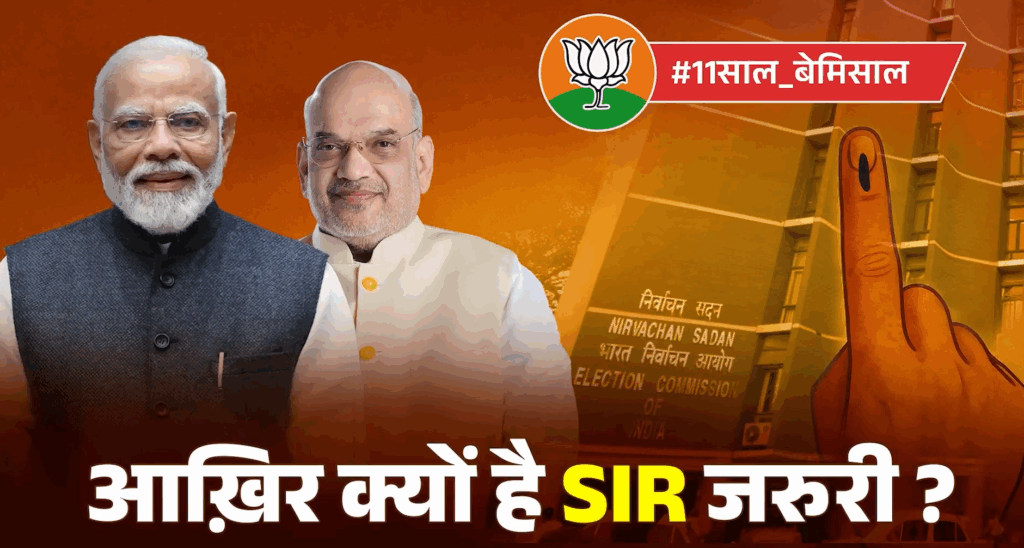
The Election Commission’s decision to revise the voter list in Bihar is driven by one primary motive: creating a clean and fair electoral roll to ensure Transparent Elections. The core goal is to identify and eliminate bogus and fraudulent voters, ensuring that only eligible citizens participate in choosing the nation’s government willingly.
The verification process has unearthed shocking instances, underscoring why the SIR is an absolute necessity for national security and integrity. Reports suggest that people from neighboring countries have managed to obtain voter IDs, pointing to a potentially well-planned conspiracy designed to weaken the country. The government’s stance is clear: no more illegal voters will be tolerated.
What is the Special Intensive Revision (SIR)?
SIR is a critical, time-bound, verification process that is centralized and conducted physically, house-to-house, to ensure electoral accuracy.
- Objective: The main objective of SIR is to remove ineligible voters, add eligible or previously missed voters, and correct errors in the voter list to prevent fraud and ensure accuracy.
- Motto: The core objective of SIR is “One Person, One Vote,” which aims to eliminate fake and duplicate entries.
- Process Simplification: SIR simplifies re-registration for migrant and transferred populations, ensuring the voter list aligns with the boundaries of the revised constituencies.
Further Viewing: Deep Dive into the Vision
For a comprehensive visual exploration of India’s ongoing electoral reforms and technological adoption, watch our exclusive video content here.
SIR in Bihar: Why Now?
The question of why Bihar was chosen for this intensive process is often raised. The Election Commission announced on June 24th that the SIR would be implemented nationwide. However, given the forthcoming Assembly Elections in Bihar, the state was chosen as the starting point for this large-scale operation—the first of its kind in two decades.
Factors Necessitating Revision:
- Demographic Shifts: Significant changes in the electorate due to increased urbanization.
- Migration: People migrating for education and employment often fail to delete their names from their old addresses.
- Fraudulent Entries: The presence of a substantial number of fake voters.
The Role of Technology and Reform
SIR promotes civic participation through awareness campaigns and simplifies voter registration via Door to Door Survey and Online Registrations, specifically benefiting marginalized sections. This reform agenda is setting the stage for more advanced electoral practices.
- Digitalisation: This drive facilitates Remote Voting for migrant voters in the near future.
- Pilot Projects: For instance, Bihar became the first state in India to launch a Mobile E-Voting pilot project for municipal elections using the E-SECBHR app. This system utilizes modern techniques like Blockchain, Facial Recognition, and Biometric Scanning for enhanced security.
Judicial Validation
The issue has even reached the Supreme Court. During the hearing on July 10, 2025, the court refused to halt the Election Commission’s process, thereby validating the constitutional need for the revision. The court did instruct the Election Commission to accept documents like Aadhaar Card, Voter ID Card, and Ration Card as valid documents during the update process.
In the future, the nation can expect clean elections free from malpractice, ensuring complete Transparency. Actual voters will be given their rightful place on the list, granting every citizen the transparent right to choose their government and ensuring their rights are protected. If we genuinely desire a system that is transparent and reformed, we must wholeheartedly welcome such initiatives.
 Previous Post
 Next Post