Elevating Half the Sky: Bihar Women Empowerment Through Decisive Governance
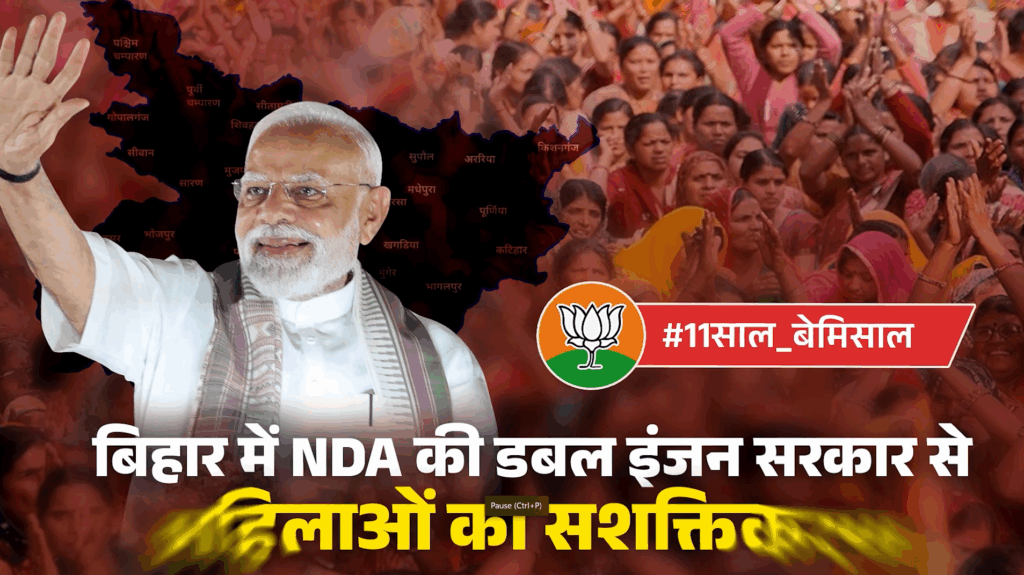
Whenever we discuss the remarkable eleven years of Prime Minister Narendra Modi’s tenure, the schemes implemented by the government for women’s dignity, upliftment, and empowerment stand out as truly commendable. Bihar, in particular, has emerged as a national model in the direction of women’s empowerment, thanks to decisive governance.
Let us examine the historical decisions taken by the NDA’s Double Engine Government in Bihar that have fostered self-reliance, provided dignity, and instilled a sense of confidence in women.
The Pillar of Political Empowerment: Reservation in Governance
The foundation of Bihar Women Empowerment rests on landmark legislative action aimed at securing political participation and dignity for women across all social strata.
Panchayati Raj Reforms
- 50% Women Reservation: Under the State Panchayat Raj Act, 2006, Bihar became a pioneer by granting 50% reservation for women in local self-governance. This was a significant jump from the traditional one-third reservation, demonstrating a serious commitment to political reform.
- Leadership Roles: Consequently, women are now holding seats from Ward Member to District Council President (Zila Parishad Adhyaksh). They are occupying the positions of Mukhiya (Village Head), Sarpanch, and Pramukh, proudly standing shoulder-to-shoulder with men.
- Comprehensive Upliftment: This reservation has undeniably improved the status of women across economic, social, political, cultural, and intellectual spheres in Bihar.
- Further Inclusion: The constitutional status granted to the three-tier Panchayati Raj system was complemented by providing 33% reservation to the Scheduled Castes and the Scheduled Tribes.
Economic Security and Skill Development
Beyond political representation, the government prioritised ensuring economic security and skill development, critical factors for genuine social empowerment.
Reservation in Government Jobs
- 35% Job Reservation: Extending the commitment to equity, the government implemented a 35% reservation for women in all state government jobs starting in 2016.
- Massive Recruitment: As a result of this policy, over 2,29,353 women have been appointed across various state departments, marking a dramatic increase in female participation in the formal workforce.
Mukhyamantri Mahila Rozgar Yojana (Chief Minister Women Employment Scheme)
- Launch and Objective: Launched on August 29, 2025, this scheme aims to provide self-employment opportunities to women, driving regional development from the grassroots.
- Financial Aid: Each family will have one woman receive financial assistance to start a business of her choice. The first instalment will be ₹10,000 for starting the enterprise.
- Structured Support: The Rural Development Department is the nodal agency. After six months, an evaluation will be conducted, and additional support of up to ₹2 lakh will be provided if necessary, supporting long-term innovation.
- Market Access: The plan includes developing local markets (Haat-Bazaar) in villages and towns for the sale of products made by women. This initiative is expected to curb out-migration from the state by creating better employment opportunities locally.
Further Viewing: Deep Dive into the Vision
For a comprehensive visual exploration of the progress and commitment to a ‘Developed India’, watch our exclusive video content here.
Education, Health, and Social Security Initiatives
Several targeted schemes have been implemented to attract girls to education and provide essential support across their lifecycle.
Education and Vocational Training
- Women’s Cycle Scheme: Initiated to encourage girls to pursue education, this scheme provides cycles, enabling easy access to distant schools and increasing school attendance.
- Balika Poshak Yojana (Dress Scheme): Aimed at attracting girls to education, this scheme provides financial aid to poor families for purchasing school uniforms.
- Free Education up to Post Graduate: The state government has ensured free education up to the Post Graduate level for women, removing financial barriers for even the poorest students to pursue higher education.
- Hunar Program: This program supports artistically skilled minority girls with ₹2,500 per student. The scheme has been expanded to benefit 50,000 girls (25,000 Muslim women and 25,000 girls from SC/ST and backward classes).
- Scholarship: The Women’s Scholarship Scheme provides ₹10,000 to every girl student who passes the Matriculation (10th) examination in the first division.
Health and Support Services
- Anganwadi Centres: The government operates 80,797 Anganwadi Centres across 534 blocks, where health and nutrition days are celebrated. These centres are equipped with weighing machines and medicines, with 63 training centres established for the workers.
- Indira Gandhi Matritva Sahyog Yojana: Pregnant and lactating mothers receive ₹4,000 as an incentive for improved health, nutrition, and safe delivery.
- Widow Pension Scheme: A monthly pension of ₹500 is provided via Direct Benefit Transfer (DBT) to widows across all social categories.
Technical Education and Security
- Women ITI Colleges: The state government established dedicated Women’s Industrial Training Institutes (ITI Colleges) under the skill development program to train women in the technical sector, supporting modern innovation.
- Women’s Police Battalion: The government has made significant efforts to include women in the police force, substantially increasing the recruitment of women for ANM and Nurse Grade-A posts, particularly during the COVID-19 pandemic.
- Hostels: Dedicated hostels were constructed for minority girl students (e.g., at Patna University, Gaya, Saran) and for backward/extremely backward female students to provide a safe and conducive environment for education.
The eleven years of the Modi government have witnessed countless remarkable efforts for women’s upliftment. Today, women in Bihar are standing shoulder-to-shoulder with men, strengthening their families’ economic position and contributing robustly to the state’s progress and future potential.
 Previous Post
 Next Post