
Zero Tolerance, Decisive Action: Operation Sindoor India Strategy Redefines National Security
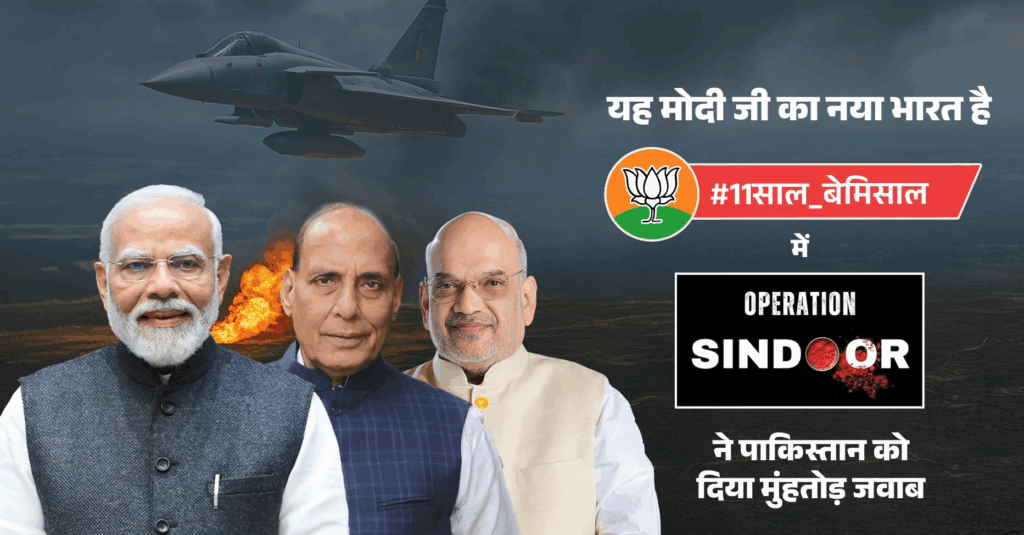
“This is the New India of Prime Minister Modi, one that, over ’11 Remarkable Years,’ has empowered the military, granting it the necessary freedom to decisively combat and eliminate terrorism.” This renewed resolve signifies a profound shift in India’s national security posture.
Operation Sindoor India Strategy stands as a powerful testament to this shift. It was a firm and clear response that upheld the nation’s integrity and sent an unequivocal message to Pakistan: “No more.” This operation was not merely a military action; it was an act dedicated to every woman who lost her husband in the horrific terror attack in Pahalgam.
While we went about our daily lives, our soldiers were not only guarding the borders but were also delivering a crushing reply to nefarious attacks from across the border, embodying the true spirit of national security.
The Catalyst for Action: The Pahalgam Attack
India’s robust stance against terrorism underscores its Zero Tolerance policy. It delivered a crucial lesson to Pakistan: the New India will not retreat; instead, it reserves the right to strike decisively at the enemy’s heart. This action demonstrated that India’s counter-terrorism policy is both firm and precise.
The Attack and the Response
The horrific incident that triggered the decisive action occurred in Pahalgam, Jammu and Kashmir, on April 22, 2025.
- The Incident: Five armed terrorists brutally murdered 26 civilians in the area.
- The Claim: The responsibility for the attack was claimed by Tehreek-ul-Mujahideen (TRF), an organisation known to be affiliated with Lashkar-e-Taiba and Hizbul Mujahideen.
Operation Sindoor: Execution and Objectives
In a powerful, well-coordinated response, India launched Operation Sindoor in the early hours of May 7, 2025, between 1:04 AM and 1:24 AM.
- Coordinated Effort: This was a commendable result of highly well-coordinated efforts by the Army, Navy, and Air Force, which delivered precise strikes against Pakistan. Crucially, a formidable Air Defence System successfully thwarted every drone and missile counter-attack launched by Pakistan, ensuring the safety of every Indian citizen.
- The Strike: India executed 24 precise strikes across nine different targets within a short span of 25 minutes.
- The Targets: The operation targeted nine separate terrorist camps in Pakistan and Pakistan-Occupied Kashmir (PoK), including locations associated with Jaish-e-Mohammed and Lashkar-e-Taiba.
- Locations Struck: Attacks were carried out in multiple locations across Pakistan and PoK, including Muzaffarabad, Kotli, and Bahawalpur.
- The Outcome: More than 100 terrorists were killed as several militant bases were successfully destroyed. The primary goal was to dismantle terrorist camps and pressure Pakistan to cease supporting terrorist activities from its soil.
Further Viewing: Deep Dive into the Vision
For a comprehensive visual exploration of India’s defence capabilities and strategic vision, watch our exclusive video content here.
Military Superiority and Technological Edge
Operation Sindoor India Strategy not only demonstrated India’s military and strategic superiority but also showcased its increasing technical capabilities through the use of advanced indigenous and imported defence systems.
Key Weapons and Defence Systems Used
India’s success was powered by its sophisticated arsenal, which overwhelmed Pakistani defence systems:
- BrahMos Missiles: These indigenous supersonic cruise missiles demonstrated high-precision strike capabilities, successfully destroying targets and infrastructure, including Chinese defence systems, in areas like Lahore, Karachi, and Rawalpindi.
- Harop Drones: These Loitering Munition drones were instrumental in targeting Pakistani radar systems, effectively weakening their defence capability.
- Barak-8 Missile Defence System: This medium-range Surface-to-Air Missile (SAM) system successfully intercepted 85-90% of the drone and missile counter-attacks launched by Pakistan.
- Prithvi Defence Vehicle (PDV): This Anti-Ballistic Missile system successfully neutralised 75-80% of Pakistani Fateh-I and Fateh-II ballistic missiles.
- S-400 Triumph: The long-range air defence system, acquired from Russia, successfully neutralised over 90% of incoming aerial threats.
- Indian Ballistic Missile Defence (BMD) Program: This multi-layered system successfully intercepted 70-75% of short-range ballistic missiles (SRBMs).
These defence systems not only retaliated for the attack but also forced Pakistan to confront India’s advanced military capabilities and strong diplomatic resolve.
Global Stature and Political Significance
The action strengthened India’s image on the global stage as a nation that takes a strong, principled stand against terrorism.
- International Response: While the United Nations appealed for peace between the two nations, India clearly articulated its position, stating that the action against terrorism would continue.
- Strategic Outcome: Operation Sindoor was a critical success, reinforcing India’s anti-terrorism policy and strengthening its international image. It was viewed as a crucial step for national unity and security, solidifying the “New India” image under the Modi government.
The campaign against the terrorist nexus fostered by Pakistan is ongoing. The government is resolutely determined to dismantle the terrorist infrastructure, a commitment that will continue until the roots of terrorism are completely eradicated from the country.
{External Link to official Government of India portal on the “Armed Forces/Defence Initiatives”}
Call to Action
Explore the official government portals detailing India’s defence modernisation initiatives and the commitment to a secure and self-reliant nation.
 Previous Post
 Next Post