
Decisive Victory: How the LWE Eradication India Strategy Is Ending Naxalism
Left-Wing Extremism (LWE) has long been a grave challenge to India’s internal security. The CPI (Maoist) has no faith in the Indian Constitution or the founding principles of the nation, believing instead in seizing power through violence. For decades, their so-called ‘protracted people’s war’ has targeted innocent citizens—including a significant number of children and women—and stalled regional development in large swathes of the country.
In the past 20 years, approximately 9,000 security personnel, tribals, youth, and civilians have been killed by these extremists. Naxalism became a persistent wound that, prior to 2014, was not only neglected but was allowed to fester under the previous Congress regime.
The last 11 years have undeniably been remarkable, with the eradication of Naxalism emerging as a top national priority.
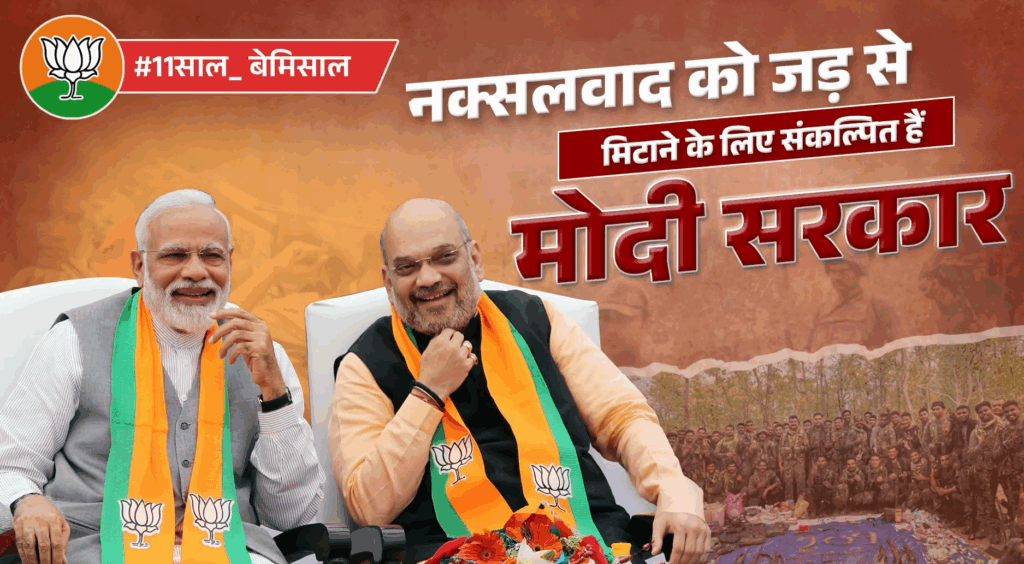
Eleven Years of Decisive Decline in LWE Violence
The substantial reduction in Naxal violence is the direct result of a precise strategy formulated under the leadership of Prime Minister Modi and the guidance of Home Minister Amit Shah.
Comparative LWE Data (2004-2024):
| Indicator | 2004 – 2014 | 2014 – 2024 | Change |
| Violence Incidents | 16,463 | 7,744 | 53% Decrease |
| Security Forces Fatalities | 1,851 | 509 | 73% Decrease |
| Civilian Fatalities | 4,766 | 1,495 | 70% Decrease |
These statistics underscore the monumental success of the government’s approach. Over the last two years, the elimination of high-bounty Naxalites is not a single-day achievement but the outcome of a sustained, strategic campaign.
The Two-Pronged Strategy
The strategy to counter LWE, approved by the Government of India in 2015, is based on two pillars:
- Security Measures: Including the deployment of Central Security Forces and capacity building of State forces.
- Development Measures: Ensuring rights and entitlements for citizens in affected areas.
Prime Minister Modi stated that Naxalism, which the Congress government had allowed to become “part of the system,” is now in its final stage. The Modi government is moving forward with the goal of ending Naxalism completely by March 31, 2026, a date poised to be a landmark in Indian history.
Further Viewing: Deep Dive into the Vision
For a detailed visual analysis of the “Security with Development” strategy and its impact on infrastructure, watch our exclusive video content here.
The End Game: Targeted Operations and Area Contraction
The strategy has now shifted from mere control to reconstruction. Home Minister Amit Shah emphasized that Naxalism is becoming a “fading shadow,” and LWE-affected regions are advancing on the path of progress due to a balance of development and decisive leadership.
Geographic Success and Security Boost
- Area Contraction: Naxal-affected districts have significantly shrunk, moving from 11 states down to pockets in only 3 states. States like Uttar Pradesh, Bihar, Kerala, and West Bengal have been fully liberated from LWE.
- Security Infrastructure:
- 702 Fortified Police Stations were sanctioned, with 621 already constructed.
- 320 new Central Security Forces camps have been established in former Naxal strongholds since 2019.
- The security budget increased three-fold since 2014, reaching ₹3,000 crore.
- The NIA and ED have actively cracked down on Naxalite funding networks and seized assets.
Major Naxal Leaders Neutralized (June 2024 – June 2025):
Recent decisive campaigns have crippled the Maoist leadership and resulted in large-scale surrenders.
- Nambala Keshav Rao (Basav Raju): CPI (Maoist) General Secretary, killed in Narayanpur, Chhattisgarh, in May 2025. (Bounty: ₹1 Crore)
- Madhavi Hidma: Platoon Commander, killed in Abujhmad, Chhattisgarh, in April 2025. (Bounty: ₹1 Crore)
- Virendra Kumar (Virendra Ganjhu): Tri-Zonal Bureau member, neutralized in Aurangabad, Bihar, in November 2024. (Bounty: ₹1 Crore)
Overall, 239 Naxalites were killed and 999 surrendered in 2025 (as of the latest data), showcasing the breaking of the Maoist network.
Development and Tribal Empowerment
The Congress government had abandoned the Tribal community to the flames of Naxalism. In contrast, the Modi government has not only brought the Tribal Community into the national mainstream and provided employment but also saw a member of the Scheduled Tribes, Smt. Droupadi Murmu, become the President of India—a clear message of profound national change and empowerment.
The focus on infrastructure, education, and health tackles the root causes of extremism.
- Connectivity: Over 14,500 km of roads have been built to connect remote areas.
- Digital Reach: Over 9,300 mobile towers have been installed since May 2014, ensuring 4G connectivity expansion.
- Education: 255 Eklavya Model Residential Schools (EMRS) were sanctioned in LWE-affected areas, with 180 already operational, dramatically increasing access to quality education.
- Skill Development: 62 Skill Development Centres and 48 ITIs were sanctioned to make youth self-reliant and employable.
- Health: A 240-bedded super-specialty hospital is being operationalized in Jagdalpur, and six central field hospitals have been upgraded with direct funding.
The “Security with Development” strategy is writing a new success story of comprehensive progress in Naxal-affected regions, securing the future potential of our tribal communities
 Previous Post