Health is Wealth: India Healthcare Transformation in 11 Years of Decisive Governance
The old adage, “Health is Wealth,” has become the guiding principle of national development. The pace of work in the health sector over the past 11 years has been truly remarkable, extending facilities once exclusive to the higher classes to the common citizen. This commitment—driven by a firm determination and a spirit of service—has laid the foundation for a healthy India.
Addressing the challenge of establishing an Affordable Health Care System for a population of 140 crore required more than just policy; it demanded a clear vision. Today, the dream of better health for every Indian citizen, envisioned by the Prime Minister, is visibly becoming a reality. Even during the devastating period of COVID-19, the country’s own vaccine saved millions of lives globally, showcasing India’s strength in medical science.
Prioritising Health: Flagship Schemes and Digital Reform
The government’s strategy has centred on comprehensive schemes that provide financial protection, expand infrastructure, and integrate technology into public health services. This multi-pronged approach underpins the India Healthcare Transformation.
Key Initiatives Driving Change:
- Pradhan Mantri Jan Arogya Yojana (PM-JAY): This flagship scheme provides a ₹5 lakh health insurance cover to over 55 crore people, effectively eliminating catastrophic health expenditures for the poor. It now extends to seniors over 70 with the Ayushman Vandan Card.
- Affordable Generic Medicines (PMBJP): A vast network of Jan Aushadhi Kendras (generic medicine stores) ensures the availability of high-quality, affordable generic medicines, making treatment for chronic diseases accessible to the common man.
- Digital Health ID and Telemedicine: The Pradhan Mantri Digital Health Mission (PM-DHM) established Digital Health IDs and Electronic Health Records (EHRs), alongside expanding Telemedicine services. This leverages technology to streamline access and care, especially in remote areas.
Further Viewing: Deep Dive into the Vision
For a comprehensive visual exploration of the progress in India’s health infrastructure and key schemes, watch our exclusive video content here.
Infrastructure and Medical Education Expansion
A healthy nation requires robust health infrastructure and a strong pipeline of skilled medical professionals. Initiatives like the Pradhan Mantri Swasthya Suraksha Yojana (PMSSY) have been instrumental in this large-scale regional development.
- PMSSY and AIIMS: The Pradhan Mantri Swasthya Suraksha Yojana (PMSSY) laid the groundwork for a Healthy Bharat. So far, 22 new AIIMS have been announced under this component: 6 are already functional, and 16 more have been approved.
- State-of-the-Art Facilities: These new AIIMS institutions are equipped with a 750/960-bedded hospital, 15-20 super speciality departments, state-of-the-art modular operation theatres (OTs) and diagnostics facilities.
- Education Growth: There has been a significant increase in MBBS and PG seats, alongside the construction of new medical colleges. Each new AIIMS facilitates 100 UG (MBBS) seats and 60 B.Sc. (Nursing) seats, with a dedicated focus on PG education and research, ensuring a future supply of talent.
Research, Innovation, and Preventive Health
The focus extends beyond treatment to Traditional & Preventive Health and innovation in the pharma sector.
- Pharma and MedTech Promotion: Schemes like the PRIP Scheme promote pharmaceutical and MedTech R&D and innovation, fostering self-reliance in the production of drugs and medical devices.
- Core Health Drivers: Focus areas like clean water, sanitation, and disease elimination (e.g., Mission Indradhanush to raise immunisation above 90%) are crucial preventive steps for overall public health.
The Rise of Uttar Pradesh: A Model of Health Sector Progress
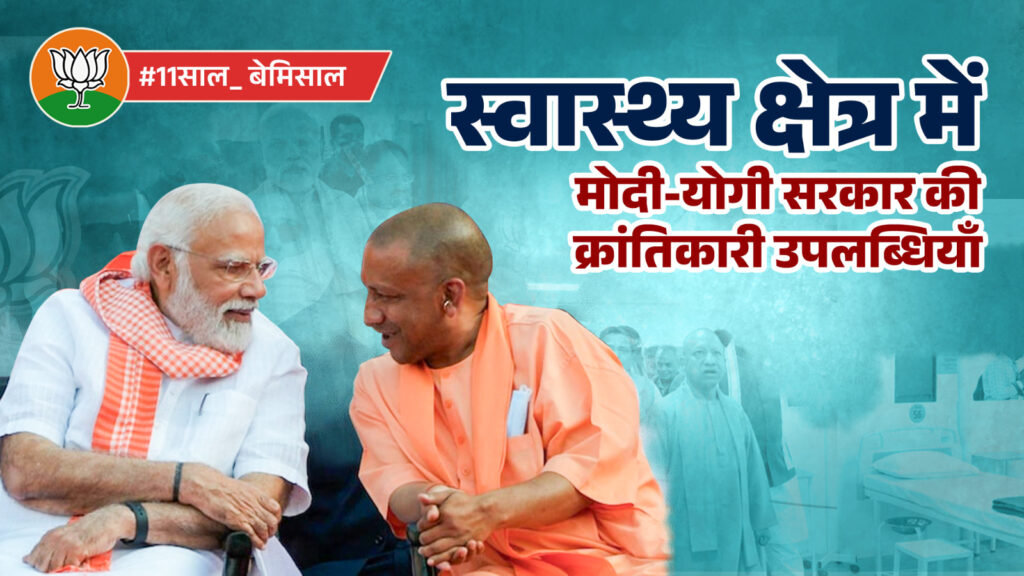
The vision of a healthy India conceived by Prime Minister Modi has been demonstrably implemented by Chief Minister Yogi Adityanath in Uttar Pradesh. The state has undergone a remarkable transformation in its health sector, serving as a powerful example of the “Double Engine” model’s impact.
UP Health Sector Benchmarks (2017 vs. 2025):
| Parameter | 2017 | 2025 |
| AIIMS | None | Rae Bareilly and Gorakhpur AIIMS (Functional) |
| Total Medical Colleges | 12 | 85 (48 Government, 37 Private) |
| Ayushman Cards | None | 5,11,72,647 |
| MBBS Seats | 5,390 (Govt: 1,840) | 11,200 (Govt: 5,150) |
| Primary Health Centres (PHC) | 3,497 | 3,976 |
These figures demonstrate a massive, targeted effort to scale up medical education and ground-level healthcare capacity in the state.
Promotion of AYUSH: The Emerging Hub
The Modi government rightly understood the significance of traditional medicine systems like Ayurveda, Unani, Siddha, Yoga, and Naturopathy. Under the leadership of Chief Minister Yogi Adityanath, Uttar Pradesh is leading the way in the AYUSH sector.
- The state government is committed to establishing Integrated AYUSH Colleges in every division to offer combined education in Ayurveda, Unani, and Homoeopathy on a single campus.
- The Chief Minister has directed that all AYUSH colleges adhere to high-quality standards, including modern laboratories, libraries, skilled faculty, and medical services.
- The establishment of Yoga and Naturopathy centres is also mandatory.
- The government has promoted the Public-Private Partnership (PPP model) in universities to ensure the reliable supply of Ayurvedic medicines.
The “11 years, remarkable years” of good governance have led to the emergence of a New UP—a key pillar in Prime Minister Modi’s vision for an Aatmanirbhar Bharat.